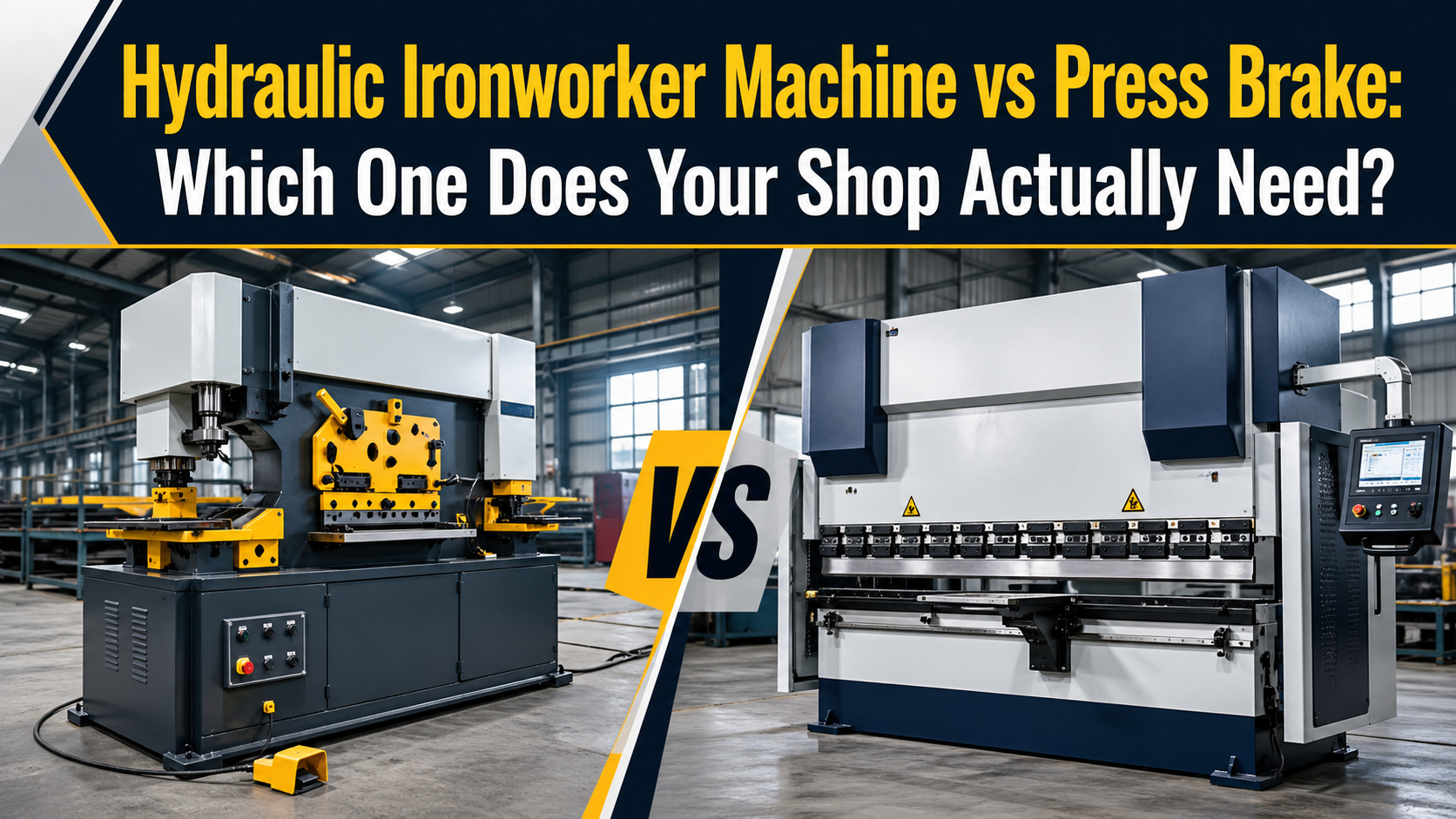
If you are setting up a metal fabrication facility or upgrading your existing equipment, you have almost certainly faced this question: should I buy a hydraulic ironworker machine or a press brake?
Both are powerful, both handle steel, and both require a significant investment. But they do very different jobs, and choosing the wrong one can mean paying for capabilities you do not use while missing the ones you actually need every day. This guide gives you a clear, honest comparison so you can make the right call for your specific operation.
What Each Machine Actually Does Hydraulic Ironworker Machine
A hydraulic ironworker machine is a multi–function machine. In a single unit it combines punching to create holes in plate and sections, flat bar shearing for straight cuts through flat bar and sheet, angle shearing for cutting angle iron at 90 degrees and 45 degrees, section and bar shearing for cutting round bar, square bar, I–beam, and channel, notching for rectangular and V– notches in plate and angle, and bending with optional press brake and angle bending attachments.
All of these operations run off a single hydraulic power unit, making the ironworker machine one of the most space–efficient and cost–efficient investments available to a structural steel fabricator.
- Press Brake
A press brake is a single–purpose machine designed exclusively for bending sheet metal and plate into angles and profiles. It uses a punch and V–die combination to press metal to a precise angle. Press brakes range from simple manual machines to full CNC hydraulic models capable of complex multi–bend profiles with sub–millimetre accuracy. A press brake does bending beautifully. It does nothing else.
- The Core Difference: Versatility vs. Specialisation
This is the heart of the decision. Ask yourself what percentage of your daily work requires bending versus cutting and punching.
If your work is primarily bending such as sheet metal enclosures, HVAC ducting, electrical panels, and decorative metalwork, a press brake is the right choice. Nothing beats a press brake for precise, repeatable bends across a full range of profiles.
If your work is primarily cutting, punching, and shearing for structural steel fabrication, gate and grill making, construction brackets, and tower components, a hydraulic ironworker machine will serve you far better. If you do both and space and budget are limited, an ironworker machine with an optional press brake attachment gives you a reasonable level of bending capability alongside full cutting and punching capability, a smart compromise for shops starting out.
- A Side–by–Side Comparison
| Feature | Hydraulic Ironworker | Press Brake |
| Punching | Yes, standard function | No |
| Flat bar shearing | Yes, standard function | No |
| Angle shearing | Yes, standard function | No |
| Section and bar cutting | Yes, standard function | No |
| Notching | Yes, standard function | No |
| Bending | Optional attachment | Primary function |
| Bending accuracy | Good for structural work | Excellent, CNC precision |
| Complex bend profiles | Limited | Yes, full capability |
| Floor space required | Single machine footprint | Similar footprint |
| Price range in India | Rs 8 lakh to Rs 80 lakh | Rs 5 lakh to Rs 60 lakh+ |
| Best for | Structural fabrication | Sheet metal forming |
- Real–World Use Cases
Buy an ironworker machine if you make steel gates, grills, and fences; structural frames and brackets; transmission tower components; solar panel mounting structures; agricultural equipment frames; railway and infrastructure components; or electrical panel frames.
Buy a press brake if you make electrical enclosure bodies and doors, HVAC ducting and sheet metal boxes, automotive body panels, decorative sheet metal products, or precision–bent profiles in thin gauge material.
Buy both if you make a broad mix of structural and sheet metal products, or complete fabricated assemblies that include both cut structural steel requiring angle shearing and section cutting and formed sheet metal components requiring accurate bending.
What About Cost?
An entry–level 55–ton hydraulic ironworker machine from an Indian manufacturer typically starts around Rs 8 to 10 lakh. An equivalent hydraulic press brake starts around Rs 5 to 8 lakh.
However, remember that an ironworker machine replaces multiple machines. If you were to buy a standalone punching machine, an angle shearing machine, a flat bar shear, and a notching
machine separately, the total cost would far exceed the cost of a single ironworker machine. The ironworker machine‘s value comes from its consolidation of five or six functions into one investment.
What HPT Manufactures
Hydro Power Tech Engineering manufactures hydraulic ironworker machines from 55 tons to 220 tons, as well as standalone hydraulic punching machines for shops that need dedicated high– volume punching. HPT also manufactures CNC angle and channel line machines for high– volume structural steel production and electrical panel door punching machines for switchgear manufacturers. If your production involves structural cutting and punching operations, HPT‘s ironworker range gives you the flexibility to handle both without needing a second machine from day one.
The Verdict
For the majority of structural steel fabricators, construction contractors, and general engineering shops, a hydraulic ironworker machine is the better first investment. It does more, takes up the same space, and costs a comparable amount to a press brake while replacing four or five separate machines and covering punching, flat bar shearing, angle shearing, section cutting, and notching in one unit.
A press brake becomes the right choice when your work is predominantly bending thin to medium gauge sheet metal with precision, particularly for enclosure manufacturers, HVAC fabricators, and sheet metal workshops. If you are not sure which is right for your operation, speak with a specialist who understands your production requirements.
Not sure which machine suits your shop? Talk to an HPT specialist today.
Contact HPT Engineering for Expert Advice
Related Reading
Hydraulic ironworker machines full specifications, hydraulic punching machines, punching applications explained, angle shearing applications, notching applications, flat bar shearing, section and bar shearing, CNC angle line machines
Frequently Asked Questions
Q: Can an ironworker machine do everything a press brake does?
A: No. A hydraulic ironworker machine with an optional press brake attachment can handle basic bending of bars, flat plates, and angle iron. For complex multi–bend sheet metal profiles requiring tight dimensional accuracy, a dedicated press brake is superior.
Q: Can I add a press brake attachment to an existing ironworker machine?
A: Many ironworker machines support optional single–V and multi–V press brake attachments that can be added at purchase or retrofitted. Confirm compatibility with your manufacturer before assuming this applies to your specific model.
Q: Which machine has better resale value in India?
A: Both hold value reasonably well. Hydraulic ironworker machines from established Indian manufacturers tend to have good resale markets because spare parts and servicing are locally accessible, making secondhand buyers confident.
Making the Investment Decision
Whether you choose an ironworker machine or a press brake, the investment logic is the same: match the machine to the majority of your production, not to your occasional requirements. If 80% of your daily work involves cutting and punching structural steel, an ironworker machine is the clear choice. If 80% involves bending sheet metal, a press brake wins.
The most successful fabrication shops invest in the right machine for their core work first, then add complementary equipment as their production mix demands. A hydraulic ironworker machine is nearly always the right first investment for a general structural fabrication shop because it gives you the widest range of capabilities from day one and the platform to grow your order book across construction, solar, tower, and infrastructure sectors.
Q: How Production Volume Affects Your Choice
Consider your daily volume carefully. A shop punching 50 holes and making 20 cuts per day has very different needs from a shop punching 500 holes and making 200 cuts. High–volume shops benefit from dedicated machines: a standalone hydraulic punching machine for punching plus an ironworker for cutting and notching, rather than one ironworker doing everything.
At medium volumes, a single ironworker machine in the right tonnage handles all requirements efficiently. At high volumes, consider pairing an ironworker machine with a dedicated CNC angle and channel line machine for repetitive structural components, letting the ironworker handle the custom and varied work while the CNC line handles the production runs. When you invest in the right machine from the start, you eliminate expensive workarounds and position your shop to grow profitably. The right decision today saves you from an expensive machine replacement in 18 months, reduces operator retraining costs, and gives your team the versatility to handle a wider range of customer work without turning jobs away.