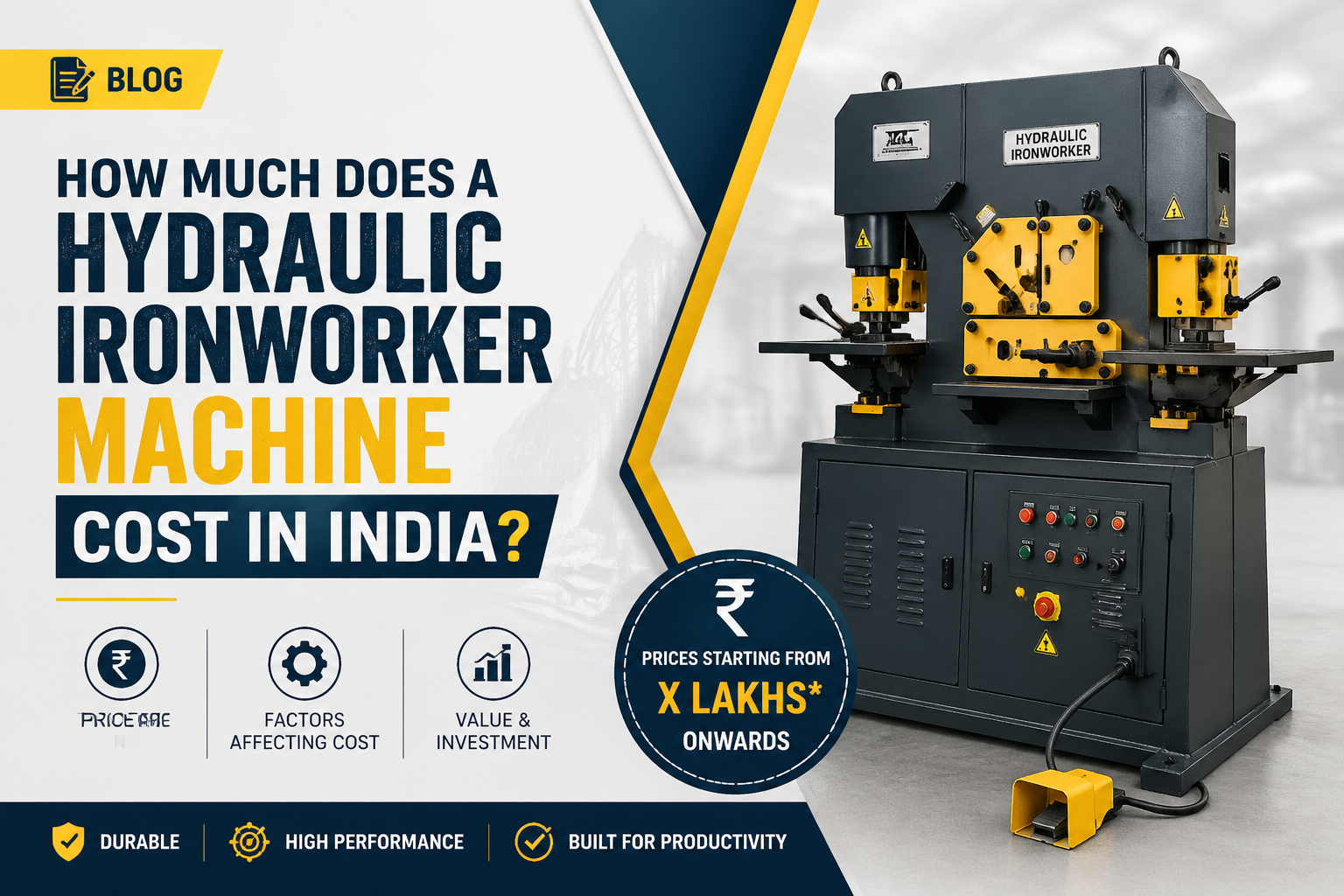
If you are running a metal fabrication shop or planning to set one up, one of the first questions on your mind is: what does a hydraulic ironworker machine actually cost in India?
The answer is not a single number. It depends on tonnage, features, configuration, and the manufacturer you choose. This guide breaks down exactly what drives the price of an ironworker machine, what you get at each budget level, and how to make sure you spend wisely before placing your order.
What Is a Hydraulic Ironworker Machine?
A hydraulic ironworker machine is an all–in–one metal fabrication tool that combines punching, flat bar shearing, angle shearing, section and bar cutting, notching, and bending, all powered by a single hydraulic system. Instead of buying five separate machines, a fabrication shop can do all these operations on one floor–standing unit and serve a far wider range of customer work.
These machines are used across construction, structural steel fabrication, solar mounting structure manufacturing, electrical panel production, railway infrastructure, and more. They are built to handle heavy steel day after day, which is why choosing the right hydraulic machine manufacturer at the right price matters enormously for your long–term production output.
Key Factors That Affect the Price
Before looking at numbers, it helps to understand what you are actually paying for when you buy a hydraulic ironworker machine.
- Tonnage (punching pressure)
Tonnage is the single biggest driver of price. Entry–level machines start at 55 tons and go up to 220 tons for heavy–duty industrial use. A 55–ton machine handles everyday punching tasks such as punching up to 22mm diameter holes in 16mm plate, shearing flat bar up to 300×12mm, and cutting 100x100x10mm angle iron. A 220–ton machine handles much heavier structural steel, including up to 40mm diameter holes in 38mm plate and 200x200x20mm angle shearing.
Higher tonnage means a heavier machine body, a larger hydraulic cylinder, a more powerful motor, and more robust tooling. All of these add to cost and all of them add to the long–term durability of the machine in your production environment.
1. Throat depth configuration (S, SD, or XD)
Throat depth determines how far from the edge of a workpiece you can punch a hole. Standard S models have a shallower throat, typically around 275 to 310mm. Deep throat SD models extend this to 510mm, and extra–deep XD models go to 760mm. If your work involves punching holes near the centre of large plates or electrical panel doors, you will need SD or XD, and the price reflects that added capacity.
2. Single station vs. multi–station
Some ironworker machines are single–station, meaning only one operation can be performed at a time. Multi–station machines allow different operators to work at the punching station, the flat bar shearing station, and the notching station simultaneously, improving total output. Multi– station machines cost more but pay back quickly in busy shops where every minute of production time matters.
3. Motor and electrical configuration
Machines range from 7.5 HP at entry level to 25 HP for the heaviest 220–ton models. Three–phase power supply requirements and motor quality affect cost and long–term running reliability, especially for shops operating in areas with variable power supply conditions.
4. Tooling and accessories included
Some manufacturers include basic punch and die sets, angle bending attachments, press brake tooling, and pipe notchers in the base price. Others charge for these separately. Always confirm what is included before comparing quotes from different hydraulic machine manufacturers.
Approximate Price Ranges in India (2025)
The following ranges reflect general market pricing for hydraulic ironworker machines manufactured in India. Imported machines from Europe or China will vary differently and come with additional freight, customs, and service considerations.
| Model Range | Tonnage | Approx. Price Range (INR) |
| Entry level | 55 to 65 ton | Rs 8 lakh to Rs 14 lakh |
| Mid range | 85 to 110 ton | Rs 15 lakh to Rs 28 lakh |
| Heavy duty | 135 to 165 ton | Rs 30 lakh to Rs 50 lakh |
| Industrial | 220 ton | Rs 55 lakh to Rs 80 lakh+ |
Note: Prices vary based on configuration (S, SD, or XD throat depth), accessories included, freight, and installation costs. Always request a custom quote based on your exact ironworker machine specifications.
What Is the Right Machine for Your Budget?
Under Rs 15 lakh: A 55 to 65 ton machine is ideal for small to medium fabrication shops doing general structural work, gate and grill manufacturing, or light industrial fabrication. You can
punch up to 22mm holes in 20mm plate and shear flat bar up to 350×15mm. This is the starting point for most shops entering structural steel work.
Rs 15 to 30 lakh: An 85 to 110 ton machine suits shops doing heavier structural steel fabrication, construction contracting, agricultural equipment fabrication, telecom tower component production, and solar mounting structures. These machines handle round bar shearing up to 50mm and angle shearing up to 152x152x15mm, covering most mid–scale structural work in India.
Above Rs 30 lakh: Machines in the 135 to 220 ton range are for high–volume industrial production including structural steel fabricators, railway infrastructure contractors, and large tower manufacturers who need to process heavy channel sections and thick plate daily with minimal downtime.
What You Should Never Compromise On
Regardless of your budget, do not sacrifice the following when choosing an ironworker machine manufacturer.
After–sales service network is the most important factor that most buyers underestimate. Can the manufacturer send a technician when something goes wrong? A machine sitting idle for two weeks costs far more than the price difference between two competing brands. Confirm service response times before signing any purchase order.
Spare parts availability matters every bit as much as service speed. Common wear parts like punch dies, shearing blades, and hydraulic seals should be locally available and affordably priced. Ask the manufacturer to show you their parts catalogue and confirm local stocking.
Warranty terms from a reputable manufacturer should cover at minimum 12 months on the machine frame, hydraulic system, and electrical components under normal operating conditions. In–house manufacturing is also critical: machines assembled from imported sub–components are difficult to repair locally. Always prefer manufacturers who machine key components themselves at their own facility.
Indian–Made vs. Imported Ironworker Machines
Many buyers consider imported machines, especially Chinese brands, due to their low upfront price. However, the total cost of ownership over 5 to 10 years tells a different story. Imported
machines often come with higher freight costs, longer lead times for spare parts (sometimes 4 to 8 weeks), and no local service support when your hydraulic punching machine or angle line machine needs urgent attention.
Indian manufacturers who make their machines in–house, like Hydro Power Tech Engineering based in Rajkot, Gujarat, offer a strong advantage: locally available spares, fast service response, and machines built for Indian power supply conditions and operating environments. With over 15 years of experience and export reach across 15 or more countries, HPT delivers machines that combine competitive pricing with proven reliability.
How to Get the Best Price
Always request a detailed quotation with exact model specifications, accessories included, motor details, and warranty terms clearly stated. Compare two or three hydraulic ironworker manufacturers but do not compare only the headline price. Compare total delivered cost including freight, installation, and first–year service commitment. Ask if the manufacturer has a demo or reference machine you can visit and inspect. Enquire about financing options as many manufacturers work with NBFC partners for equipment financing at competitive rates for metal fabrication machinery.
Ready to get an accurate price for your specific requirement?
Request a Free Custom Quote from HPT
Related Reading
Hydraulic ironworker machine specifications and models, hydraulic punching machine options, understanding flat bar shearing, section and bar shearing capabilities, angle shearing applications, notching applications, CNC angle and channel line machines
Frequently Asked Questions
Q: What is the minimum budget to start with an ironworker machine in India?
A: A reliable 55–ton hydraulic ironworker machine from an Indian manufacturer can be purchased starting around Rs 8 to 10 lakh, fully installed. This is enough for most small fabrication shop requirements including general punching, flat bar shearing, and angle shearing.
Q: Is GST included in the quoted price?
A: Typically, machine prices are quoted ex–works, excluding GST and freight. Always confirm this with your supplier and factor in 18% GST and delivery costs when budgeting for any hydraulic machine purchase.
Q: How long does delivery take?
A: For in–stock models, delivery typically takes 2 to 4 weeks from an Indian manufacturer. Custom configurations may take 6 to 10 weeks. Contact HPT Engineering to confirm lead times for your specific model.
Understanding the Total Cost of Ownership
When evaluating price, never look only at the purchase price. The true cost of an ironworker machine includes installation, commissioning, tooling such as punch and die sets, annual maintenance, consumables including oil and filter elements and shearing blades, and any downtime costs when the machine needs servicing.
A well–built machine from a reputable Indian hydraulic machine manufacturer may cost Rs 2 to 3 lakh more than a cheaper alternative but save that amount and more in reduced downtime and lower maintenance costs over five years of production. Shops running double shifts accumulate operating hours rapidly, making component quality the most important cost factor over time rather than the purchase price alone.
A machine with a fast punching cycle, quick blade gap adjustment at the flat bar shearing station, and reliable hydraulics completes more work per shift than a slower, cheaper alternative. Over a year, this throughput difference can translate into significant additional revenue for your metal fabrication business.
What the Right Machine Does for Your Business
The right hydraulic ironworker machine does more than cut and punch metal. It determines how many jobs you can take, how quickly you can complete them, and how competitively you can price your work. A shop with a 220–ton machine can take structural contracts that a 55–ton shop simply cannot bid for. A shop with reliable punching machines and angle shearing capability quotes shorter lead times and wins more business.
For fabrication shops in India looking to grow into solar structures, transmission tower components, pre–engineered buildings, or heavy construction, the ironworker machine sits at the centre of that growth. Investing in the right machine at the right time is one of the most impactful decisions a fabrication business owner makes.